
On July 24, 2025, Google introduced Google Web Guide, a tool that blends AI-generated summaries with classic organic web links. It sounds convenient, but there’s a familiar question here: do all-in-one solutions end up feeling like a compromise, never quite matching the best-in-class performance of specialized tools? That’s the challenge Google must overcome. Can a “Search Guide” point you to the perfect link as swiftly as a traditional search engine, while also breaking down complex topics as smoothly as an AI chatbot? Can it really give us the best of both worlds? Let’s see!

Google Search Labs vs Search Generative Experience vs Google Web Guide
Sorting through Google’s mountain of AI jargon is no small task, as the company often renames its tools before users even get used to them. To understand where Google Web Guide sits in this mix, it helps to step back and look at the bigger picture.
Google Search Labs is Google’s experimental playground, where adventurous users can try out new features long before they hit the mainstream. One standout project was the Search Generative Experience (SGE), which put AI front and center, serving up summarized answers right at the top of your results (right now, this initiative is called AI Overviews, and we even wrote an article about it!). Building on this, Google rolled out Web Guide in July 2025, a solution that organizes search results into neat, magazine-style sections with clear thematic categories.
What is Google Web Guide
This “two-in-one” approach brings together the quick, conversational feel of AI with the tried-and-true dependability of traditional web links. Instead of just showing a long list of links, this tool groups information into clear sections, such as AI summaries and advice from online communities. In other words, it makes finding what you need easier by sorting results by topic and showing AI summaries at the same time. But enough talk, let’s see how it looks in reality:
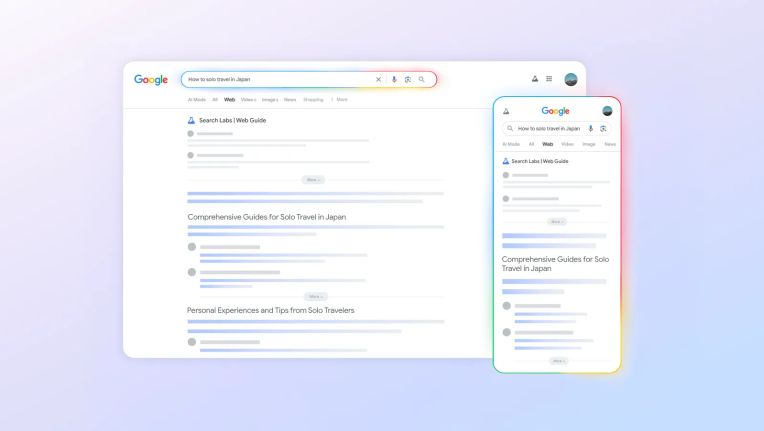
How does it work
Understanding how Google’s new “Web Guide” functions reveals how search is shifting from a basic tool to a personalized AI assistant. Here is a simple breakdown of the technology driving this new experience:
- Google Web Guide transforms a single broad search into multiple specific sub-queries to provide a more comprehensive answer;
- This process, known as “Query Fan-Out”, happens entirely on Google’s servers before your results page even finishes loading;
- The system personalizes these subqueries by analyzing factors such as the user’s Google search history, interests, and current location;
- By loading the page structure first and populating the AI content second, Google keeps the experience fast despite the complex background processing.
Get started with Google Web Guide via Search Labs
To enable Google Web Guide:
1. go to the Search Labs website,
2. choose the Experiments tab,
3. find the Web Guide card,
4. and join the experiment.
Unfortunately, it’s currently only live for testers in the United States, but it will expand to additional locations throughout 2026.
Stay ahead: AI insights for digital publishers
Web Guide is just one piece of a much larger puzzle. While Google refines its search experiments, it is simultaneously championing responsible AI innovation through projects like People + AI Research (PAIR), aiming to establish global standards for human-AI interaction. A key part of this effort is the People + AI Guidebook, a collection of practical guidance designed to help creators build human-centered AI products.
Are you interested in AI topics? Our optAd360 blog features regular updates from the ad tech world, and also deep dives into AI, providing digital publishers with the tools they need to thrive in a machine-learning world.
Read also

Extending the streak of success – we’ve been recognized by Forbes!
We are thrilled to announce that, once again, we are among the laureates of the prestigious Forbes ranking!
Read more
Google, CMP, and new requirements for publishers
Have you heard about the recent announcements from Google regarding Consent Management Platforms? If you're a digital publisher, this news is something you should be keeping an eye on!
Read more